
The Milkshake Study Reveals A Lot About Why Diets Don’t Work
The Mind over Milkshakes study reveals many insights about Hunger Hormones and Your Relationship With Food
Diet culture tells us that our food should be “light,” “as few calories as possible,” “never indulgent.” These messages shape not only what we eat, but also our relationship with food.
But is that really helping you reach your goals?
In my counseling sessions (and my own experience), I hear over and over how dieting works…but only short term and only if we are measuring body size changes and nothing else. That isn't because my clients don't have willpower, it is because we are not meant to diet. Chronic dieting disrupts our relationship with food and pulls us further away from our body’s natural cues. There is lots of research on this topic. (For more details on why diets don't work check out my blog on why I take a non-diet approach.)
But today I want to share another reason diets don't work. It has to do with our perception of what we are eating. And to explain this better, I want to share a mind-blowing study.
It is called the Mind Over Milkshakes study.
The Mind Over Milkshakes Study: How Food Labels Affect Hunger Hormones
Participants were invited into a lab and given a milkshake to drink. Every person received the exact same shake.
It contained 380 calories. The calories don’t really matter, what is important is that all participants were drinking an identical shake.
The only difference was the label.
Some participants were told they were drinking a rich and indulgent 600 calorie shake.
Others were told it was a light and sensible 150 calorie shake.
And here's where it gets interesting!
While they drank the shake, researchers measured ghrelin levels, a hormone that rises when you’re hungry and naturally drops as you begin to feel full. Ghrelin plays a role in appetite regulation.
What the Study Found: Ghrelin, Fullness, and Perceived Satisfaction
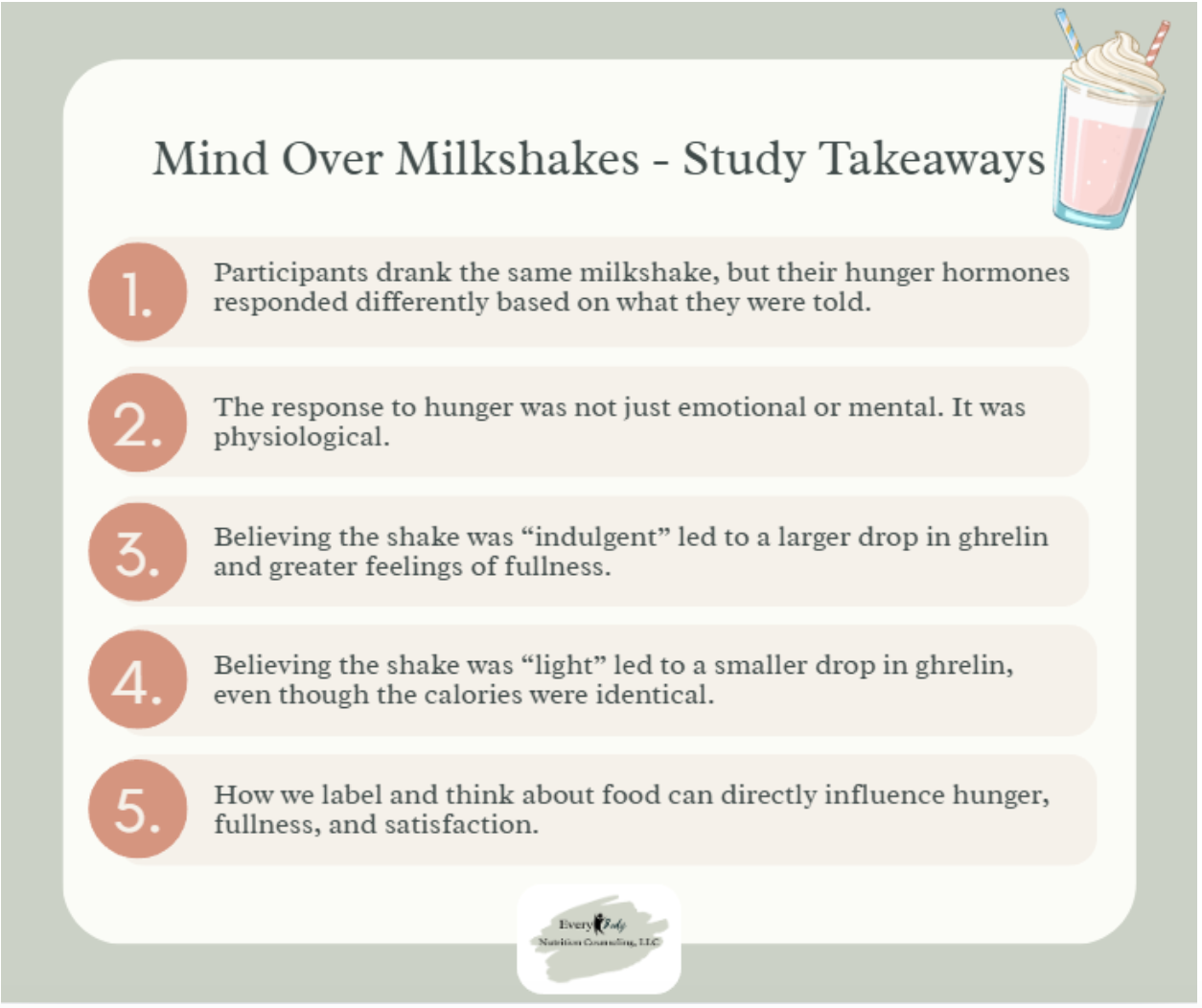
Even though everyone drank the same shake, their bodies’ hormones and hunger responded as if the labels were true. People who believed they were drinking the indulgent shake had a larger drop in ghrelin.
Their bodies registered more fullness and satisfaction.
People who believed they were drinking the light shake had a smaller drop in ghrelin, even though the shake was identical. This means the body responded not only to the nutrients in the shake, but also to the story people were told about it.
The response was not just emotional or mental. It was physiological.
What the Milkshake Study Teaches Us About Diet Culture, Chronic Hunger, and our Relationship With Food
This explains yet another reason diets don't work. If everything you eat is supposed to be low calorie and “sensible,” then your body’s hunger and fullness hormones will respond to this. Over time, this can erode your relationship with food, making it harder to trust hunger, fullness, and satisfaction. Hunger isn’t simply a reflection of food intake, but part of a much more complex system.
Dieting doesn't lead to long term sustainable changes. Instead, it leaves you feeling like you are failing yet another diet. It further distances you from hearing, understanding, and responding to your own internal signals.
Letting go of the idea of diets is hard work. Everywhere we turn, we’re bombarded with diet culture’s message. Learning to dismantle that hold is something that I work on a lot with my clients.
If you are tired of the dieting rollercoaster and ready to explore how ditching diet culture can free you from the restrict-binge cycle, book a free consult to learn more about how I can support your journey.
Why Hunger Hormones Aren’t Just About Calories
This study highlights that hunger isn’t controlled by nutrients alone, but the relationship between hormones and hunger goes much deeper. Understanding this can bring relief if you experience hunger concerns related to weight gain or weight loss, or feel unsure how hunger fits into your overall health.
Hormones, expectations, permission, and the emotional context of eating shape our experience and our relationship with food. This aligns with principles often discussed in mindful eating, where satisfaction and awareness matter just as much as nutrients. This isn’t about tricking yourself or forcing positive thoughts. It’s about understanding that your body is responsive and attuned to your lived experiences.
For anyone working to heal their relationship with food, this research offers reassurance. Your body isn’t malfunctioning, but rather it’s deeply influenced by the environment around eating.
If hunger feels confusing or frustrating, working with a registered dietitian through nutrition counseling can help you better understand how hormones, stress, and eating patterns influence hunger and fullness.
Diet Culture Shapes Hunger, Fullness, and Satisfaction in Daily Life
You might notice this in your daily life. Maybe a meal feels more satisfying when you allow yourself to enjoy it without guilt. Or maybe a food feels less filling when you label it as “light” or “good.” These moments offer important insight into your relationship with food.
There’s no right or wrong way to feel. Hunger is simply information your body is offering you over time.
Sometimes hunger may be influenced by factors beyond food alone, such as stress and other emotions. Here are a few gentle questions you might explore:
How do my expectations about food influence how satisfied I feel?
Do I notice a difference when I give myself permission to enjoy something?
What stories do I carry about certain foods, and where did they come from?
How have these stories shaped my relationship with food over time?
The Mind Over Milkshakes study reminds us that hunger isn’t a personal failure or a lack of willpower. Our bodies respond to expectations, permission, and context, not just calories.
When eating is framed through restriction and “shoulds,” hunger often gets louder, not quieter. Understanding this can be a powerful step toward rebuilding trust with your body and stepping off the dieting rollercoaster.
Nutrition Counseling Can Help You Rebuild Trust with Hunger and Fullness
Your body responds to more than just calories or labels. It actually responds to your beliefs, your history, your emotions, and your sense of permission. Simply knowing that mindset plays a role can help you approach eating with more compassion and less pressure. Your body is worthy of trust.
If you’ve ever found yourself asking, “why am I still hungry after eating,” this mind over milkshakes study offers an important reminder: hunger isn’t a flaw to fix. It’s information your body is offering you. If tuning into those cues feels complicated, you’re not alone. Rebuilding trust takes time and compassion.
Believing you’re allowed to enjoy food isn’t automatic. It’s a skill that takes time and support to develop. Helping clients cultivate permission, satisfaction, and a healthy relationship with food is central to my work as a dietitian nutritionist.
If food takes up a lot of mental space for you, or if hunger cues feel confusing or stressful, you don’t have to work through that alone.
👉 Book a nutrition counseling session if you would like guidance in building trust, satisfaction, and confidence around food.
I accept major insurance networks, and most of my patients work with me for $0 out of pocket. I can see patients in person in Chelmsford, MA, or virtually if you’re located in MA, NH, MT, OR, TX, CO, and CA.